Physics sprint
QWOP
Four keys, four muscles, one hundred metres. Almost nobody finishes, and that has been the joke since 2010.
- Made by
- Bennett Foddy
- Released
- 2010, rebuilt without Flash in 2016
- Shelf
- Platform · 2–5 minutes
- One session
- Runs of ten seconds to a minute
- Account
- No account
- Connection
- Loads once, then runs on your device
- Controls
- Four keys — Q, W, O and P — or on-screen buttons
- Pays its way with
- Nothing at all
- Last retested
- 22 September 2026
Opens the developer's own site in a new tab. The link is editorial: nobody paid for it, and we get nothing if you click it.
- To start
- £0, nothing to install
- Most it will sell you
- Nothing on the web version
- Paid random items
- None
Every price, with its source: what each cabinet really costs.
The first five minutes
You press Q. A leg swings somewhere it should not. You press W to correct it and the athlete folds into the track. The first minute is pure slapstick; the second is when you notice the physics are consistent, and that people who can run fifty metres are doing something deliberate.
What you are actually doing
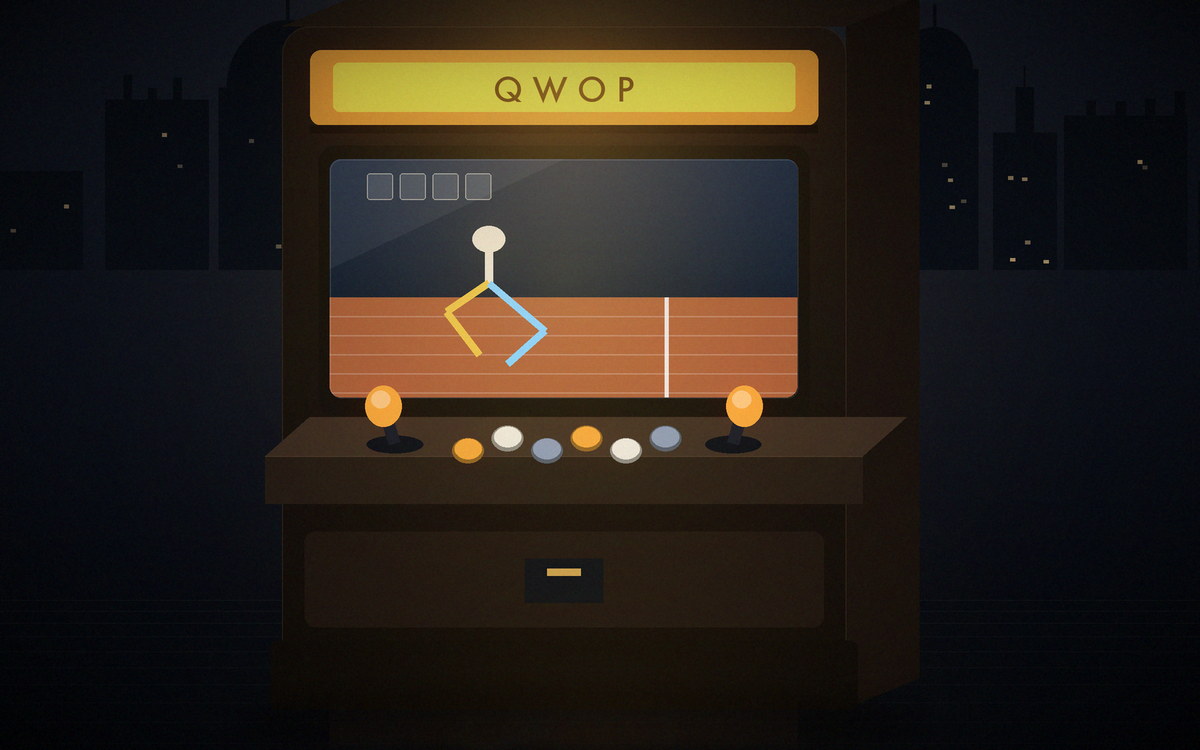
Q and W drive the thighs, O and P the calves. That is the entire control scheme, and it is the whole game: a sprinter's stride broken into four muscles you have to conduct in order, against gravity that never gives you a second chance.
Bennett Foddy — who went on to make Getting Over It, and who teaches at the NYU Game Center — built it in 2010 as a study in deliberately awkward controls. It moved off Flash to HTML5 in 2016, so it still opens today with nothing to install.
Why it belongs on the short shelf
The average run lasts a few seconds. There is no save, no progress bar and nothing to lose by closing the tab mid-stride, which makes it the ideal thing to open while a kettle boils or a build finishes.
It is also the best game here for a room: hand the keyboard over, let someone else have a go, and the whole thing becomes a spectator sport. Foddy's own page notes it works on a phone with on-screen buttons, though four muscles under two thumbs is a different kind of challenge.
The honest snag
It is a joke with a very long punchline. Most people will play for fifteen minutes, get a personal best of about eight metres, and never open it again — and that is a perfectly good outcome. If you want a game that rewards steady practice, the stacker two cabinets down will treat you better.
What works
- Free, advert-free, and hosted on the developer's own page
- A complete run fits in the time it takes to read a message
- Nothing is ever lost by quitting — there is nothing to lose
- Runs entirely in the browser once loaded, so a tunnel is fine
What grates
- The four-key scheme is deliberately horrible; some people bounce off in a minute
- On-screen buttons on a phone are cramped compared with a keyboard
- No leaderboard or progression on the official page, so improvement is its own reward
The verdict
Sixteen years old and still the quickest way to make a stranger laugh. It costs nothing, wants nothing and ends in seconds. Marked down only because the reason to come back tomorrow is thinner than the reason to open it today.
Questions we get asked
Is QWOP free to play in a browser?
Yes, on Bennett Foddy's own site. It was rebuilt without Flash in 2016, so no plugin is needed.
Can I play QWOP on a phone?
The official page offers on-screen buttons for touch devices. It works, though the keyboard version is far easier to control.
How long is a game of QWOP?
One attempt usually lasts a few seconds. Getting past fifty metres takes most people several sittings.